
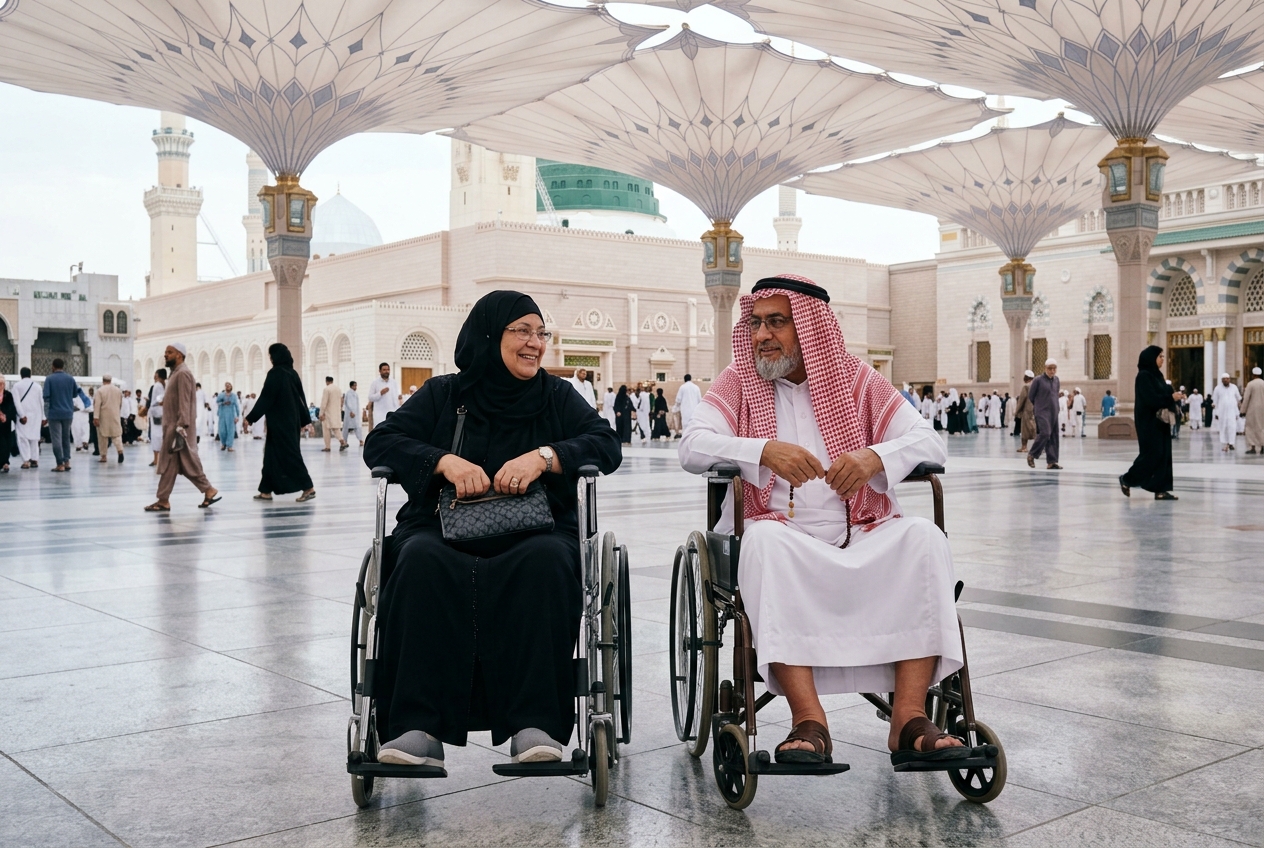
Every year, millions of travellers visit Makkah and Madinah, and many of them are elderly, recovering from illness or simply unable to walk long distances. Both cities are welcoming, but they are built around two of the largest mosques in the world. Planning ahead, stage by stage, makes the whole journey calmer and easier.
1. Before you fly
Start with the airline. Request wheelchair assistance when you book, not at the airport. Most airlines offer help from check-in to the aircraft door, and again on arrival.
Next, think about mobility support at your destination. In peak seasons such as Ramadan, wheelchairs, hotel rooms near lifts and train seats sell out early, so book them together with your flights.
Finally, pack light and smart: well-cushioned shoes, a refillable water bottle, a small umbrella for shade, and a printed list of medicines with doses.
2. Arriving in Saudi Arabia
Most international visitors land in Jeddah or Madinah. Both airports have assistance services, but queues can be long at busy times, so keep your hotel address in Arabic and English on your phone and on paper. If you are arriving in Jeddah, Dintravel’s guide to Jeddah, the gateway to Makkah is a helpful introduction to the city.
For the road transfer, book a car with a large boot so a wheelchair fits easily.
3. Your hotel
When you contact the hotel, ask specific questions:
- Is there a step-free entrance and a lift to every floor?
- Can we have a room close to the lifts?
- Is the bathroom fitted with a walk-in shower or grab rails?
Get the answers in writing. A good hotel makes daily life much easier, but even the closest hotels still involve a lot of walking once you reach the mosque.
4. Moving around the mosques

This is where most travellers feel the strain. Visitors walk between gates, prayer halls, lifts and their hotel several times a day, and walking several kilometres on a busy day is common. Plan your day around one main visit and rest in between.
There are four main ways to get support:
1- A family member pushes a manual wheelchair. It costs nothing, but it is tiring for the helper.
2- A hired pusher, paid per visit at the mosque.
3- Your own wheelchair, useful at airports, though someone still has to push it.
4- A rented electric wheelchair, driven by the traveller with a simple joystick.
An electric chair gives the most independence over a longer stay. Assist Haramain provides electric wheelchair rental in Makkah and Madinah, delivered to your hotel, with no security deposit. The battery covers around 17 to 20 km on a full charge, enough for a full day.
5. Travelling between the two cities
The Haramain High Speed Railway is the most comfortable way to travel between Makkah and Madinah. Book seats early in busy seasons and arrive at the station with time to spare. A foldable wheelchair travels with you on the train or in a car boot, and with Assist Haramain you can receive a chair in one city and return it in the other.
6. Heat, rest and health
Summer temperatures in Makkah often pass 40°C, so the cooler months from November to February are kinder to elderly travellers. Whatever the season, go out early, drink water regularly, and rest in the hotel during the hottest hours. Keep medicines in your day bag, not your suitcase.
Quick checklist
- Airline wheelchair assistance requested
- Mobility support booked for your whole stay
- Hotel lifts and step-free access confirmed in writing
- Hotel address saved in Arabic and English
- Medicines and a printed list in your day bag
- One main visit planned per day
With good preparation, limited mobility doesn’t have to limit the journey. Every traveller, whatever their age, can experience Makkah and Madinah calmly and at their own pace.


